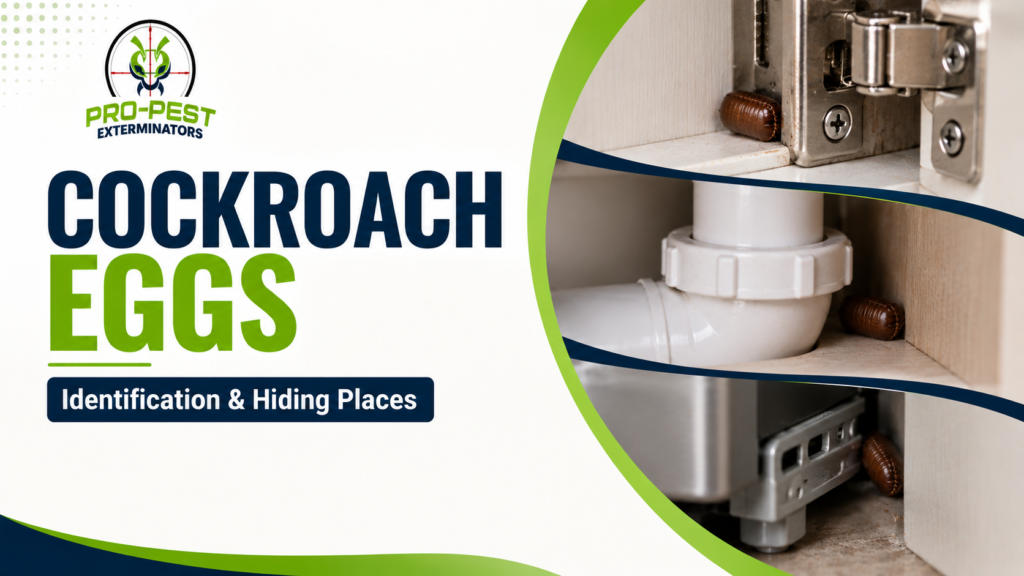
Finding cockroach eggs inside a cabinet, behind an appliance or near a drain can indicate reproductive activity. The case’s shape, seam, location and condition help identify the species and determine whether the eggs may have already hatched.
Quick Answer
Cockroaches enclose their eggs inside a protective capsule called an ootheca. The case usually looks like a small tan, brown or dark reddish-brown capsule with a firm shell and a ridged seam. A split seam may indicate that the young cockroaches have emerged.
Key Takeaways
- People usually find the complete egg case instead of separate eggs.
- German and American cockroach cases differ in shape, egg count and placement.
- An opened seam provides the strongest visible sign of a hatched case.
- One case requires inspection, though it cannot establish infestation size by itself.
- Removing the visible case does not reach other cockroaches inside nearby harbourages.
What Do Cockroach Eggs Look Like?
The object commonly found inside a property is an ootheca, which contains several developing eggs. Its colour and dimensions vary across cockroach species.
A typical ootheca has:
- A capsule, purse or bean-like shape
- A tan, brown, reddish-brown or dark brown shell
- A firm outer surface
- A straight or ridged seam along one edge
- A length of several millimetres
- A regular shape that distinguishes it from crumbs and waste
Colour cannot confirm the species or hatch status. The outer shell can darken as it hardens, and older cases may collect grease, moisture or dust.
Individual eggs remain inside the ootheca
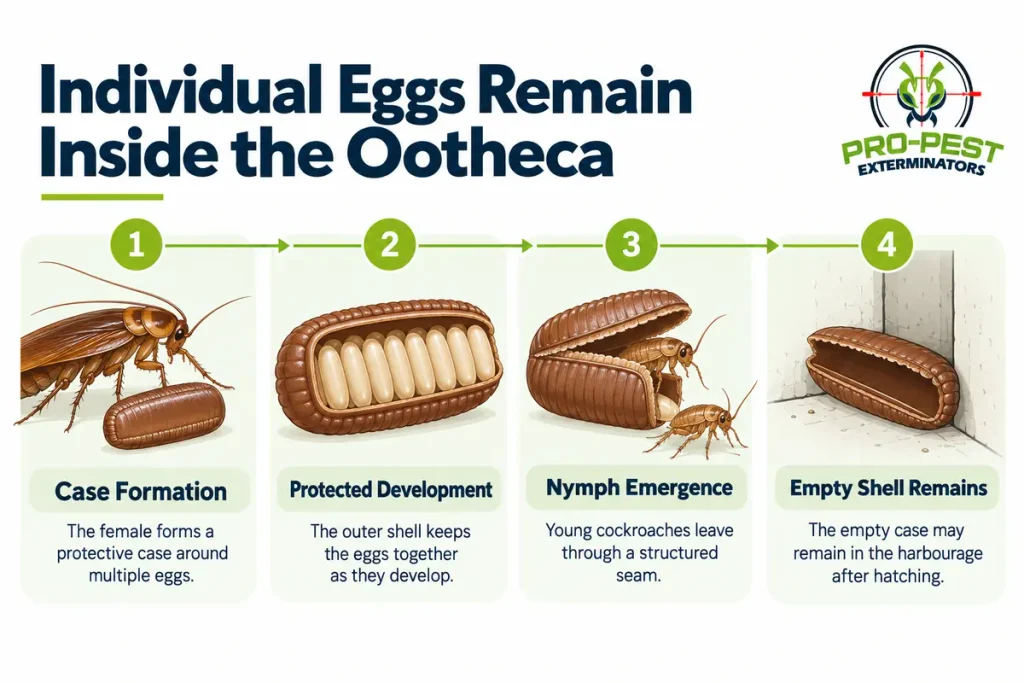
A female cockroach forms a protective case around multiple eggs. The outer shell keeps the eggs together and supports their development until the nymphs emerge.
Young cockroaches leave through a structured seam along the case. The empty shell can remain in the harbourage long after the hatch.
Egg cases and cockroach droppings look different
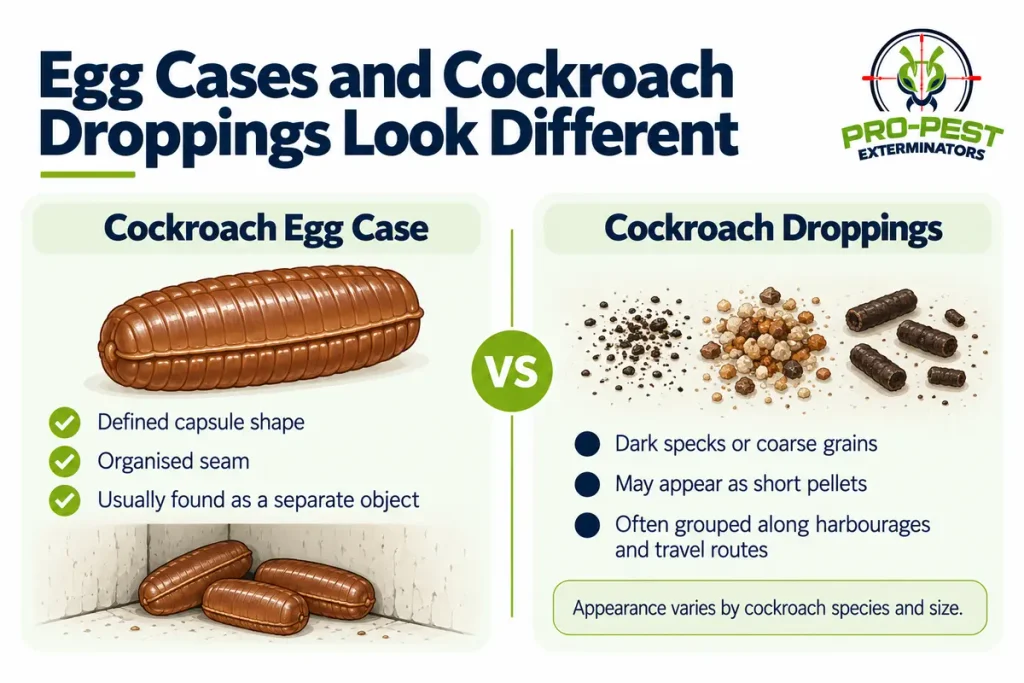
Cockroach droppings may appear as dark specks, coarse grains or short cylindrical pellets. Their appearance depends on the cockroach species and size.
An ootheca has a defined capsule shape and an organised seam. Droppings often collect in groups along harbourages and travel routes. Egg cases usually appear as separate objects, although several may accumulate in a regularly used hiding place.
Seeds and food fragments can cause confusion
Seeds, crumbs and food fragments may share the colour or approximate size of an egg case. Their surfaces usually show plant fibres, irregular breaks or uneven contours.
Photograph the object beside a ruler before moving it. Capture the seam, side profile and surrounding location because these details support identification.
A property inspection provided through professional pest control services should identify the object and active pest before treatment begins. This prevents a seed, dropping or unrelated insect case from leading to the wrong application.
German and American Cockroach Egg Cases
German and American cockroaches produce cases with different shapes and reproductive patterns. Location and female behaviour often provide more useful clues than length alone.
| Feature | German cockroach ootheca | American cockroach ootheca |
|---|---|---|
| General appearance | Narrow, tan or light brown capsule | Broader, brown or dark brown purse-shaped capsule |
| Typical length | About 8 mm | About 8 mm |
| Profile | Slim and elongated | Wider and thicker |
| Approximate egg count | 30 to 40 | Around 16 |
| Female behaviour | Carries the case until close to hatching | Deposits the case early in its development |
| Common locations | Cabinets, appliance gaps and warm indoor harbourages | Protected areas near drains, plumbing and food |
| Likely property source | Indoor breeding population | Indoor harbourage or nearby drainage route |
These measurements describe typical specimens. Age, physical damage, viewing angle and natural variation can change their visible appearance.
German cockroach ootheca
A German cockroach case has a narrow and elongated form. The female carries it at the end of her abdomen through most of the incubation period.
NC State Extension describes the case as approximately 8 mm long, 3 mm high and 2 mm wide. It commonly contains about 40 eggs. The female may retain it until the young begin emerging.
A loose German cockroach case inside a kitchen deserves a wider inspection. This species frequently establishes indoor populations near food, warmth and moisture.
Check:
- Cabinet hinges
- Drawer runners
- Refrigerator motors
- Gaps beneath counters
- Under-sink plumbing
- Microwave and oven spaces
- Cracks around fitted cabinets
Small nymphs, droppings and adults near the discovery point provide additional evidence of an active indoor population.
American cockroach ootheca
An American cockroach case has a broader, purse-shaped profile. The female deposits it in a protected location near food and may attach it to a surface.
The University of Florida reports an approximate size of 8 mm long and 5 mm high. Each case commonly contains around 16 eggs. Its shell appears brown after deposition and becomes darker within the following days.
American cockroaches commonly occupy sewers, drains and damp utility areas. An ootheca near plumbing can indicate a nearby harbourage, indoor reproductive activity or repeated movement through the drainage system.
Adult size cannot identify the case
An adult American cockroach grows much larger than an adult German cockroach. Their egg cases can still have a similar length.
The American ootheca usually has a wider profile and holds fewer eggs. Shape, location and reproductive behaviour therefore provide better identification evidence than length alone.
Where Cockroaches Hide Their Egg Cases
Cockroaches use protected spaces that give newly hatched nymphs access to food, water and shelter. The hiding location also helps identify the likely species.
Kitchen cabinet joints and hinges
German cockroaches regularly occupy fitted kitchens. Cabinet hardware creates narrow spaces that protect adults and young nymphs.
Inspect:
- Hinge recesses and mounting holes
- Drawer runners
- Shelf joints
- Loose laminate edges
- Gaps beneath countertops
- Corners near food storage
- Openings around sink pipes
An ootheca has greater significance when the same space contains droppings, nymphs or repeated night-time activity.
Refrigerator and cooking-appliance spaces
Refrigerator motors, microwaves, ovens and other appliances create warm and sheltered areas. Grease, crumbs and nearby moisture can support continued activity.
Use a torch to examine appliance edges, cable openings and floor-wall junctions. Keep heavy and connected appliances in a safe position during the inspection.
Under sinks and around plumbing
Leaking fittings, pipe openings and damp cabinet bases create favourable harbourages. These areas can support German cockroaches and provide entry routes for larger species.
Check the wall opening around each pipe, the rear cabinet corners and the spaces behind stored items. Moisture staining can reveal a leak that supports the population.
Bathrooms, drains and service ducts
American cockroaches can move through drains, shared ducts and service routes in apartment and commercial buildings.
Common inspection points include:
- Floor drains
- Waste-pipe openings
- Access panels
- Utility cupboards
- Pipe chases
- Damp wall cavities
- Nearby manholes
The full population may occupy a drain, concealed void or connected sewer route. The discovery point alone cannot locate the source.
Cardboard boxes and stored materials
Cardboard folds and undisturbed storage provide protected spaces. Packaging can also transport an egg case into a property.
A single case discovered immediately after opening a delivered box requires inspection around the unpacking area. Several cases of different ages inside permanent cabinetry provide stronger evidence of continuing indoor reproduction.
Furniture and upper areas
Brown-banded cockroaches use warmer and drier locations than German cockroaches. Their oothecae may appear beneath furniture, behind wall hangings, inside wardrobes or near electronics.
These locations show why a kitchen-only inspection can miss some species. The distribution of evidence should determine which rooms require examination.
Empty and Unhatched Egg Cases
The seam offers the most useful visible clue when assessing hatch status. Physical damage and age can still make the result uncertain.
Signs of a hatched case
A hatched ootheca commonly has:
- An opened seam
- A hollow interior
- Separated sections along the emergence edge
- Small nymphs in the surrounding area
Young cockroaches can disperse after emerging. Their absence beside the shell does not prove that the case remains unhatched.
Newly emerged nymphs may look pale until their cuticle hardens and develops its normal colour. This stage can produce a reported white cockroach sighting close to the harbourage.
Signs of a potentially unhatched case
A completely closed seam and intact shell may indicate that the case has not hatched. Visual inspection cannot determine whether the eggs remain viable.
A closed case may contain developing eggs, nonviable eggs or dried internal material. Keep the object intact until you have photographed its identification features.
Damage can resemble a hatch opening
Cleaning, crushing, moisture and general wear can break an old case. Random damage often creates irregular edges. Natural emergence usually opens the structured seam.
A broken case cannot provide a reliable hatch-status answer when its emergence edge has suffered extensive damage.
What an Egg Case Reveals About the Infestation
The case confirms that a female produced or transported an ootheca into that location. Its species, condition and surrounding evidence determine the strength of the infestation signal.
One isolated case
A single case may have arrived through packaging, remained after an earlier infestation or come from a cockroach that entered recently.
Inspect the surrounding area and place monitoring traps near the discovery point. Current activity on the traps provides more useful evidence than the case alone.
A closed case inside an indoor harbourage
An intact case inside a cabinet hinge, appliance gap or another protected indoor space suggests that a female used the location for reproduction.
Check connected harbourages for adults, droppings and nymphs. German cockroaches rarely occupy one isolated cabinet gap when food, water and shelter remain available throughout the kitchen.
An opened case with nymphs nearby
An opened emergence seam and several small nymphs provide strong evidence of recent hatching. The young cockroaches may spread into adjacent gaps soon after they emerge.
Removing the shell will not affect nymphs that have already left it.
Several cases of different ages
Several intact, opened and darkened cases in the same area indicate repeated use of the harbourage. This pattern provides stronger evidence of an established reproductive population.
Cockroaches use connected cracks, cabinet joints and appliance spaces. The visible cases may represent one section of a larger harbourage network.
A female carrying the case
A female carrying a protruding ootheca provides current evidence of reproduction. German cockroaches retain their cases through most of the incubation period and release them close to hatching.
UC Integrated Pest Management describes this extended carrying behaviour in German cockroaches. Other common species usually deposit their cases earlier.
Supporting Evidence to Check
The object provides one part of the identification. Related evidence helps establish the species, harbourage and activity level.
Check for:
- Black specks or cylindrical droppings
- Shed exoskeletons
- Small wingless nymphs
- Live adults after dark
- Grease-like smear marks
- A musty smell inside enclosed areas
- Food residue around cabinet edges
- Leaking plumbing
- Openings around pipes and cables
- Repeated activity around drains
Adults, nymphs and egg cases found together provide the strongest evidence of an indoor reproductive population. Several signs across connected areas also help determine the treatment boundary.
An ootheca cannot explain an unexplained skin reaction. The guide to a suspected cockroach bite explains why the appearance of a skin mark cannot identify the pest responsible.
What to Do After Finding Cockroach Eggs
Preserve the identification evidence, remove the discovered case and examine the connected harbourage. These actions help establish whether the case represents isolated transport or continuing activity.
Photograph the object and location
Take photographs before moving the case. Include a ruler or familiar object for scale and capture:
- The top surface
- The side profile
- The ridged seam
- The discovery location
- Other pest evidence nearby
An inspector can use these details after you discard the physical case.
Seal and discard the case
Wear disposable gloves and lift the object with tissue or a suitable tool. Place it inside a sealed bag and discard it in a covered outdoor bin.
Wash your hands afterward. Clean nearby food-contact surfaces with a product approved for that surface and follow the product label.
Inspect connected hiding places
Begin at the discovery point and examine adjoining cabinets, drawer runners, appliances, plumbing openings and wall edges.
Avoid spraying unidentified chemicals inside electrical equipment, food-storage spaces or inaccessible cavities. Follow every pesticide label and keep products away from children, pets and food.
Monitor for current activity
Place cockroach monitoring traps along wall edges and near suspected harbourages. Label each trap with its placement date and location.
Check the traps regularly. Captured adults or nymphs help confirm current activity and identify the areas that need greater attention.
Remove supporting conditions
Clean food residue, grease and crumbs from concealed edges. Store food inside sealed containers and empty household rubbish regularly.
Repair leaks, reduce cardboard storage and close accessible entry gaps once you understand the active harbourage pattern.
Why Removing One Case Does Not Resolve the Problem
The discovered ootheca may represent one part of an active reproductive cycle. Other cases, nymphs and adults can occupy connected harbourages.
Household aerosol spray may kill exposed cockroaches without reaching the full population inside cabinet gaps, appliances or plumbing routes. Do not assume that a spray will kill the developing eggs inside a closed case. Its result depends on the formulation, active ingredient and approved label use.
Professional cockroach control services use species, hatch status, activity distribution and entry routes to determine the treatment scope. German cockroach activity inside cabinets requires a different approach from American cockroach movement through drains.
Property layout, infestation extent and required treatment also influence the cockroach control cost. The visible case alone cannot establish the quotation because the surrounding areas may contain additional life stages and harbourages.
When the Property Needs an Inspection
Arrange a detailed cockroach inspection when you find:
- Several egg cases
- An intact case inside a kitchen harbourage
- Nymphs beside an opened case
- Adults and young cockroaches together
- Evidence in several cabinets or rooms
- Repeated sightings after dark
- Continued activity after previous treatment
- Cockroaches moving through drains
- Egg cases inside a restaurant or food-storage area
Pro-Pest Exterminators uses the case, hatch status, surrounding life stages and discovery location to assess cockroach activity in Karachi properties. These findings help identify the species and define the areas that require treatment.
Conclusion
A cockroach egg case provides useful evidence when its shape, seam, location and surrounding signs receive proper consideration. An opened case can indicate recent hatching, and several cases of different ages can point to continuing reproduction inside the property.
Removing the visible ootheca addresses only the object you found. Inspect connected cabinets, appliances, plumbing routes and other protected spaces for nymphs, adults and additional cases. Recurring evidence requires species-based treatment that reaches the active harbourages and entry routes.
Frequently Asked Questions
How many cockroaches can emerge from one egg case?
The number depends on the species. A German cockroach ootheca commonly contains about 30 to 40 eggs. An American cockroach case commonly contains around 16.
Can an egg case hatch after the female dies?
A deposited case may continue developing when it already contains viable eggs. German cockroaches carry their ootheca until close to hatching, so the case’s maturity at the time of separation affects the outcome.
What colour is a cockroach egg case?
A cockroach ootheca can appear tan, brown, reddish-brown or dark brown. Its species, age and outer-shell development influence the colour. Colour alone cannot provide a reliable identification.
Does one egg case mean I have an infestation?
One case confirms that a cockroach produced or transported it into the location. Nymphs, droppings, repeated sightings and several cases provide stronger evidence of an active indoor infestation.
How can I tell whether an egg case has hatched?
A naturally opened seam and hollow interior commonly indicate hatching. An intact seam may indicate that the case remains unhatched, though visual inspection cannot confirm whether the eggs remain viable.
Where do cockroaches usually place their cases?
German cockroaches favour warm indoor harbourages near food and moisture, including cabinet hinges and appliance gaps. American cockroaches use protected locations near drains, plumbing and damp utility areas.
Can household spray kill the eggs inside an ootheca?
Do not assume that household spray will kill eggs protected inside an ootheca. The result depends on the product’s active ingredient, formulation and label instructions. Effective control must also address adults, nymphs and harbourages.
Should I crush a cockroach egg case?
Keep the case intact long enough to photograph its shape and seam. Seal it inside a bag for disposal, clean the discovery area and inspect nearby harbourages. Crushing one case does not address other cockroach life stages.